
Classical music composed in the years following World War II is known for its high level of experimentalism. With countless new techniques for composition being developed, composers began to place less emphasis on more traditional “rules” and sources of inspiration. The generally more sterile and atonal works of this period feature broader harmonic and rhythmic characteristics than earlier twentieth century…
Tag: Essays
Stravinsky and Satie: Making Meaningless Music
Music is, by its very nature, essentially powerless to express anything at all, whether a feeling, an attitude of mind, a psychological mood, a phenomenon of nature, etc.… Expression has never been an inherent property of music. Igor Stravinsky, 1936 The classical music world was overturned in the first half of the twentieth century. Various new genres and methods developed,…
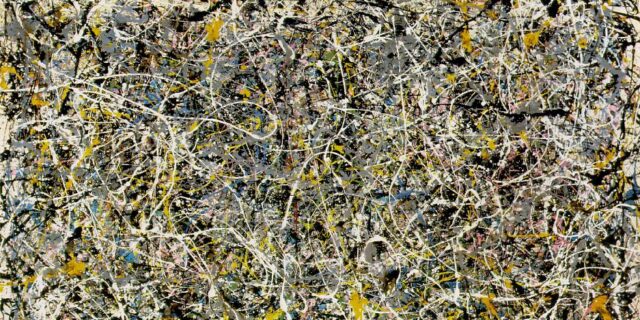
Reducing Pollock’s “Number 1” to a Familiar Language of Symbols
Jackson Pollock’s Number 1, painted in 1949 via his revolutionary “drip” method, is essentially incomprehensible. As it hangs on the wall at The Museum of Contemporary Art (MOCA) in Downtown Los Angeles, countless visitors stare at its incredible depth. Rich, layered details of varying colors form a multitude of shapes, intertwined to create a work that is considered art. The…
Sculpting “The Other Tiger”
This essay was originally written for the course “Symbols and Conceptual Systems”, with Professor Roberto Díaz at the University of Southern California. It is relevant here for its interactive format and interdisciplinary approach, and the underlying topic of abstraction in visualization. “The Other Tiger” by Jorge Luis Borges conjures a tiger with its text. Next, Borges compares his imaginary tiger…