
As of December, 2025, the Cello Expressions Sheet Music Library now includes 200 pieces. To celebrate this milestone, this post looks at statistics for the current library. Values and distributions will continue evolving as pieces are added and occasionally removed. The purpose of this library is to expand the repertoire of music for cello ensembles of various configurations; at this milestone, this goal has been achieved.
Timeline
Let’s start by looking at when each active piece in the library was published. A few caveats: pieces are sometimes published (especially pre-2015) with back-dates to when they were originally written, and sometimes not. Pieces are also periodically removed for various reasons. So this is a representative look, with number of pieces and total durations by year:
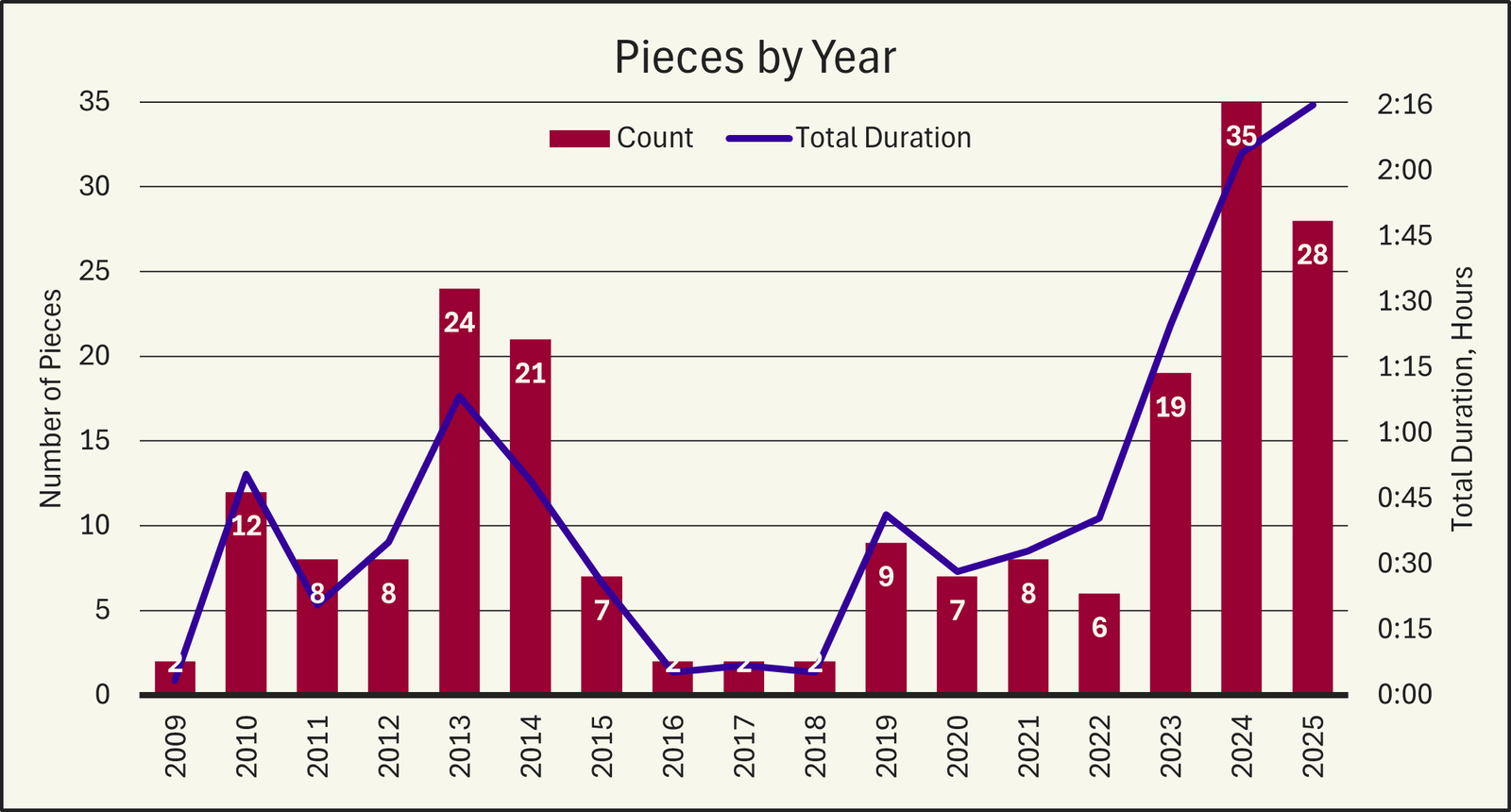
Some listings in the library are fairly short, while others comprise multiple sub-pieces (such as 12 Etudes for Two Cellos) or lengthy multi-movement works. Pictures at an Exhibition is the longest piece in the library at 27:20, also available for solo cello at a condensed 22:57. I published over one hour of music in 2013 and 2023 and over two hours in 2024 and 2025. Here’s a look at the average duration of all pieces published in a given year:
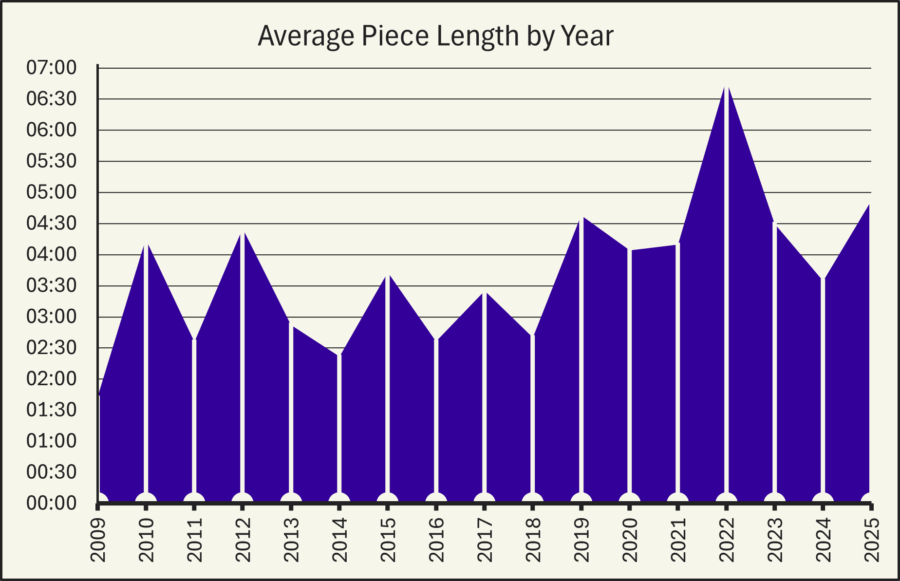
The 200 pieces in the library total around 12 hours and 45 minutes at the marked tempos. We can also have some fun with dates to observe the frequency of publication within each calendar month across all years:
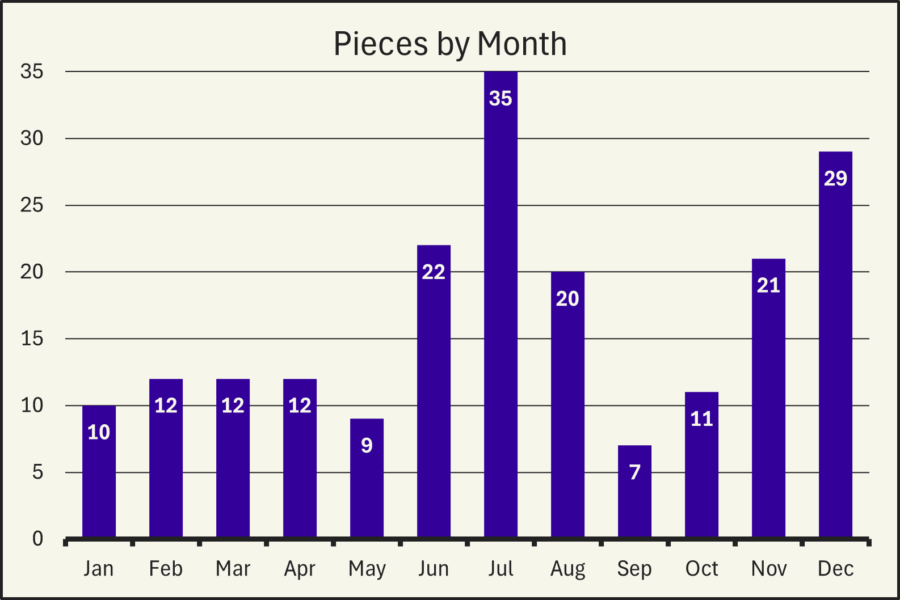
Given the breadth of arrangements now in the library, and the fact that its goal has been to expand the repertoire of music available to cello ensembles, I expect a slowing in the pace of new pieces in the coming years, rather than a continuation of the recent upward trend. That being said, I would be surprised if fewer than five new pieces are published in a given year in the future. (My 2021 prediction was only 3-5 a year, so we’ll see…)
Orchestrations
My sheet music library uses the orchestrations taxonomy from the plugin for two distinct purposes: to describe the overall orchestration, and to list the parts included. Let’s start with a visualization of orchestrations:
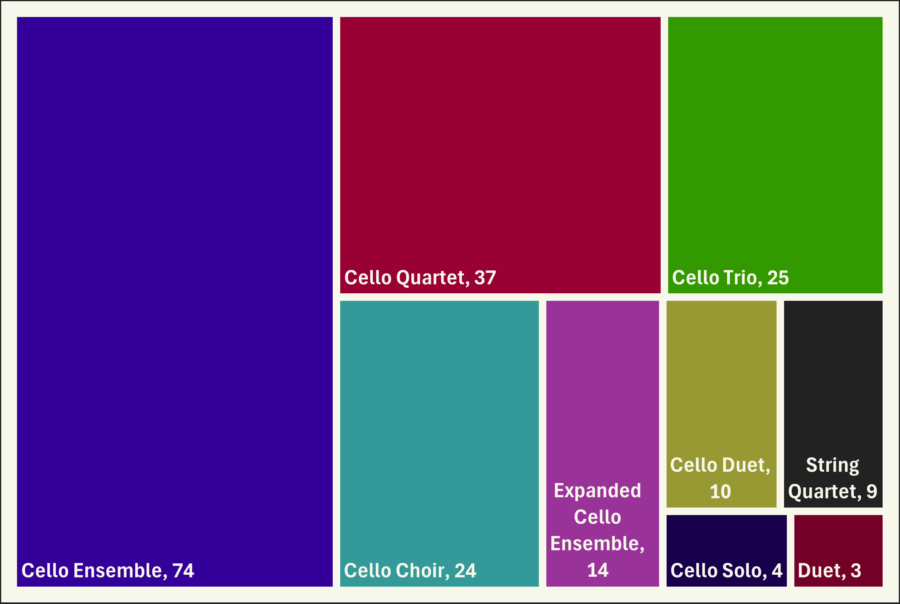
These largely correlate to the number of cello parts, where the concentration is clearly around music for four cellos. Comprising two-thirds of the library, these pieces are more specifically tailored to quartets of four musicians, ensembles of up to twelve cellists, or larger cello choirs. Most of these larger groups continue to use four parts. This is because, through trial and error, I’ve found that this is the most effective level of complexity for most groups to blend. Five or more parts are only provided for pieces that warrant greater complexity based on their source material.
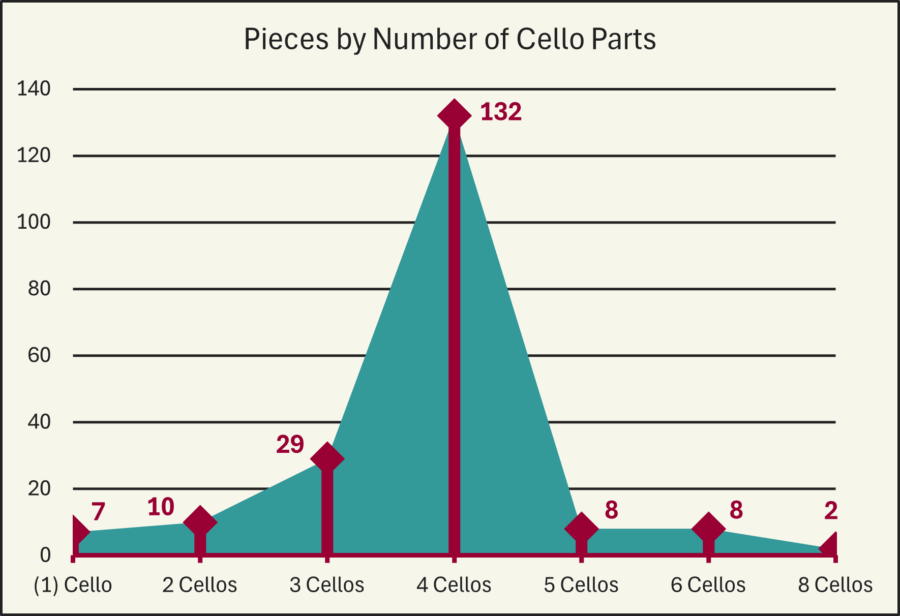
In the chart above, single-cello music includes solos and mixed duets. It does not include the nine pieces for string quartet. These correlate, of course, to nine pieces with a viola part and with two violin parts. While there are no other pieces in the library with violin or viola parts, several other instruments make frequent appearances in mixed and expanded ensembles.
Nine pieces feature a trumpet part; my second instrument, trumpet typically blends nicely with cello ensembles. Seven pieces feature flute, dating to Boulder Cello Project arrangements thanks to their dual-instrument member. Four pieces with unpitched percussion round out the most-frequent instruments. Several other wind instruments and pitched percussion appear in one or two pieces in the current library.
Difficulty by Orchestration
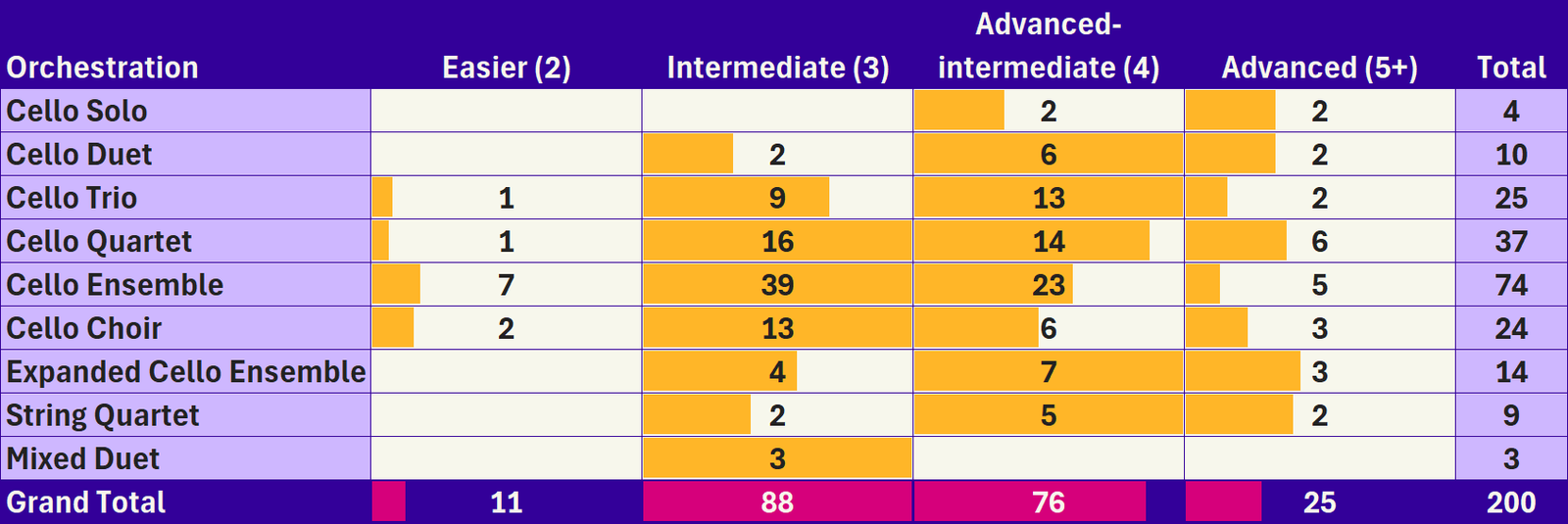
Finally, let’s break the orchestrations down by difficulty. This taxonomy is somewhat de-emphasized in the library because so much of the music falls into the intermediate and advanced-intermediate terms. However, the difficulty rankings are fairly consistent and I’ve gradually lowered the average difficulty of pieces over time. Easier is not beginner, but closer to what might be defined as grade 2 on a 5-6-grade scale. Intermediate would be grade 3, followed by advanced-intermediate at 4, with the use of tenor/treble clefs and/or notes above fourth position being the most common differentiator between these two. Advanced and professional difficulties are combined due to the smaller quantities, but represent a broad range from very to exceptionally difficult, with a good spread across orchestrations.
Genres
Genres present an imprecise metric, since a given piece may fall into multiple categories, there are some large sub-categories, and lots of music struggles to fit into clean taxonomies in this vein. Ignoring precision, if we accept the imperfect system currently applied to the library, genres appear with the following frequency:
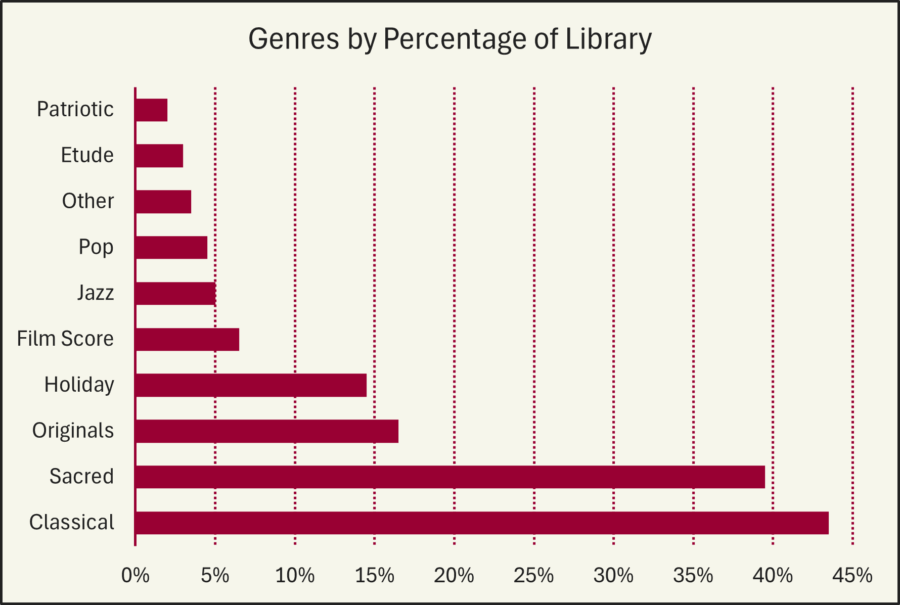
A major inconsistency occurs with the application of sacred versus classical genres. Much of what we consider classical music was written for sacred purposes, and the library generally follows this approach for pre-nineteenth-century pieces. From the romantic era onward, most sacred music, particularly hymn tunes, is not also listed in the classical genre, except for pieces that are particularly well known in secular contexts. We’ll take a closer look at the classical and hymn tune genres since they each comprise a large percentage of the current library.
Classical Sub-Genres and Composers
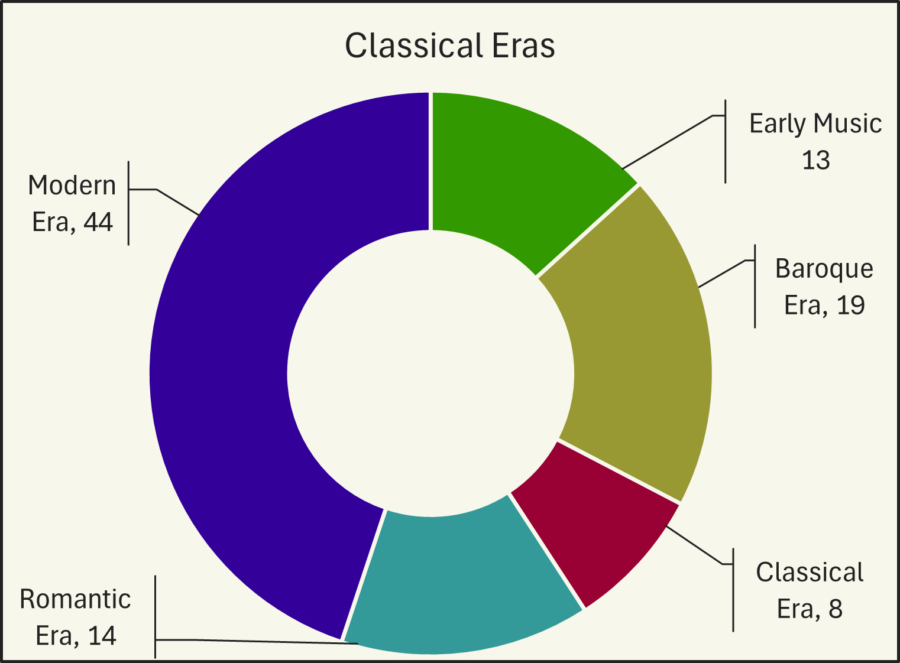
Since the “Classical” Genre has a total of 99 pieces (including 12 pieces in sub-categories excluded from the primary category ranked above), let’s break it down in more detail, looking at eras and composers. The classical eras in the library follow the generally accepted ranges of pre-1600, 1600-1750 (Baroque), 1750-1800 (Classical), 1800-1900 (Romantic), and 1900-present (Modern, including originals).
The library includes concentrations of a few composers with lots of pieces, and an enormous tail of thirteen composers featured twice and seventy composers on a single piece. I top the list with 35 Original pieces. There are 23 Traditional (various origin) pieces and 15 American Traditional pieces. From there, we can look at a list of pieces by composer, filtering out composers that are lesser known or genre-specific (hymn tunes, jazz, etc.) to get a representative picture of the form of the library.
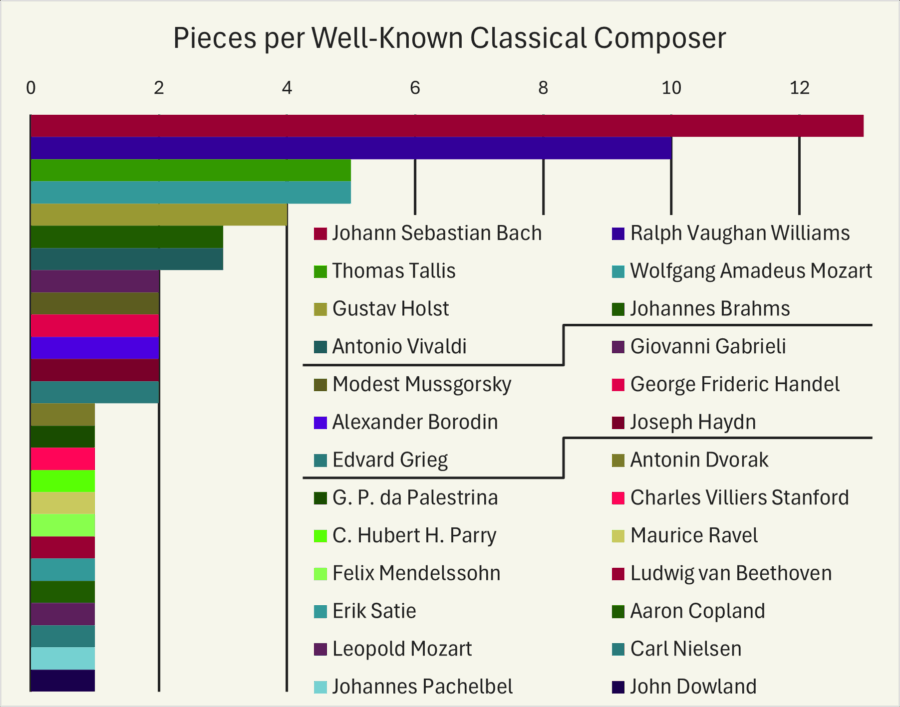
Note that this shows pieces across all genres by “classical” composers. Many of them appear in the library through sacred works such as hymn tunes.
Hymn Tunes
I began publishing hymn tune arrangements in earnest in 2023. This genre has driven the significant growth of the library in the past couple of years, now totaling 59 arrangements. However, the hymn tune index presents a more complete picture of 68 pieces by including common hymn tunes that are published under their better-known names derived from text pairings or other cultural sources. It also lists my hymn tune arrangements for non-cello groups, which are mostly unpublished and excluded from the online sheet music library. (These are all available on request.) The following chart summarizes all 95 hymn tune arrangements by orchestration:
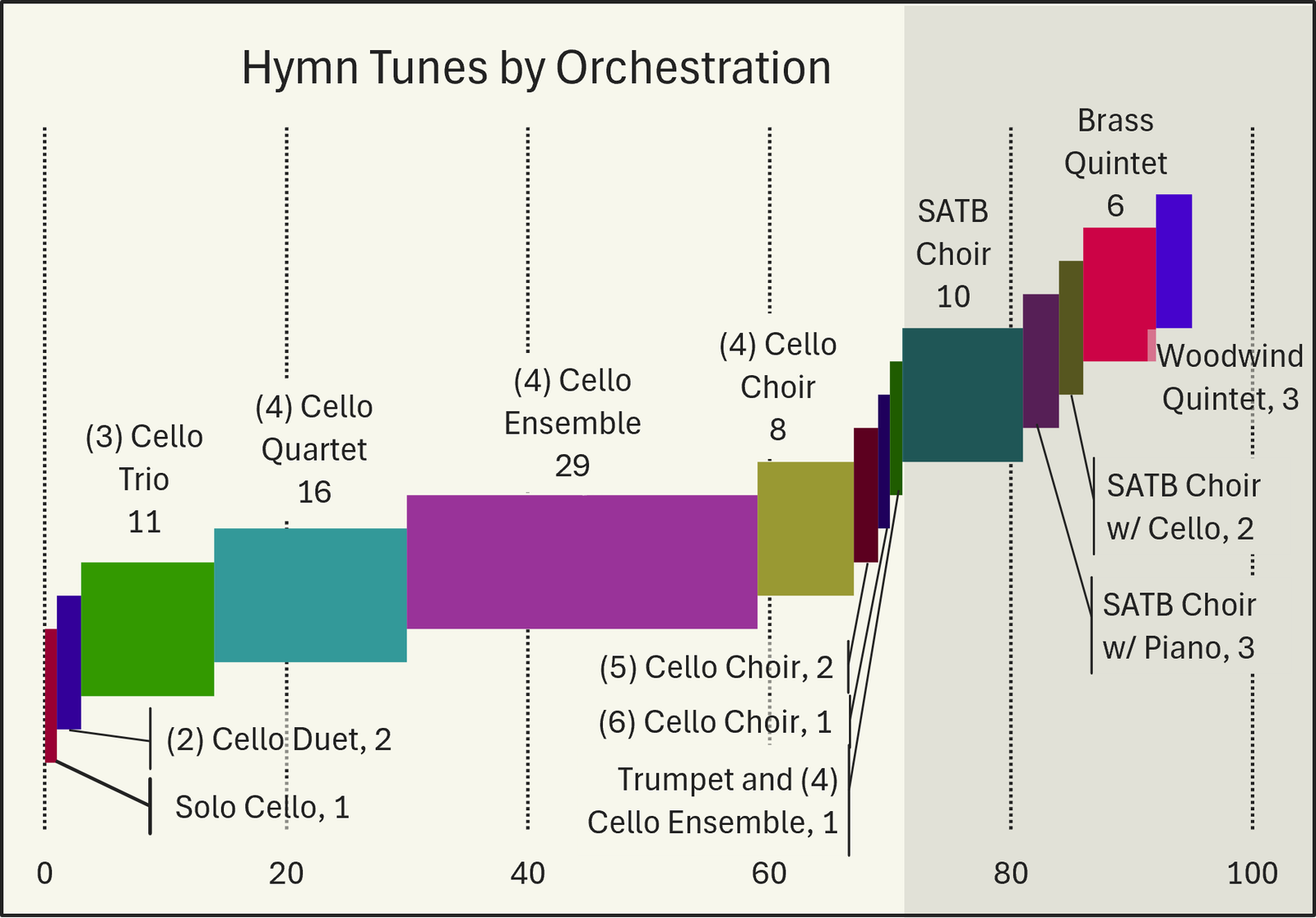
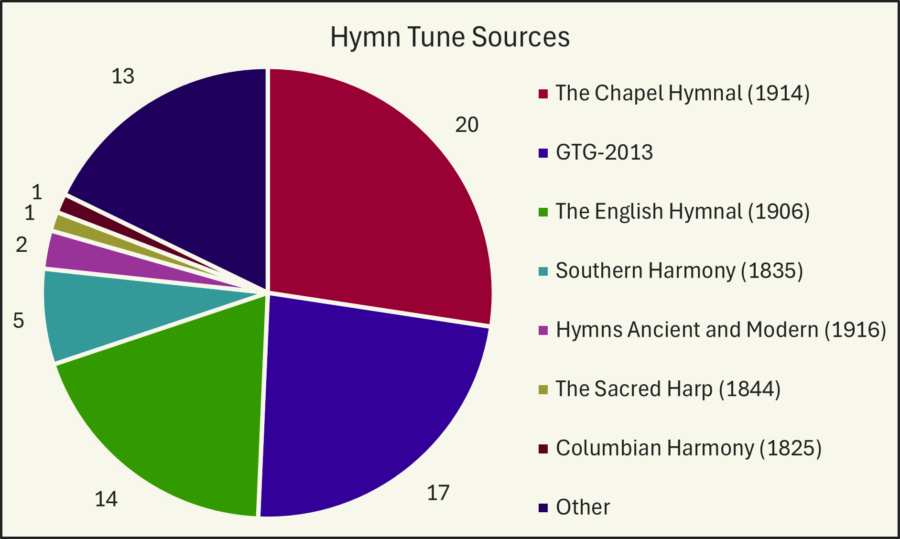
While there is some repetition of hymn tunes by the same composer, there is also a broad diversity similar to the distribution amongst classical composers. Hymn tune sources, on the other hand, reveal a fairly even distribution to describe the content of this genre within the library.
Popularity
While I have only limited data on site visits and downloads, this section explores those numbers between August and November 2025. Note that 13 new pieces were published during this window, so they have lesser potential for traffic while also each spending some time at the top of the home page under new releases. This data only considers individual pieces, not archive or taxonomy page views.
During this four-month period, the music site has averaged 129 piece views per day, totaling around 15,000 views on individual piece pages. This is roughly consistent with the volume that I’ve seen for the life of the library, scaling up with the increase in piece count. There appears to be a steady and growing demand for cello ensemble music.
Individual Piece Popularity
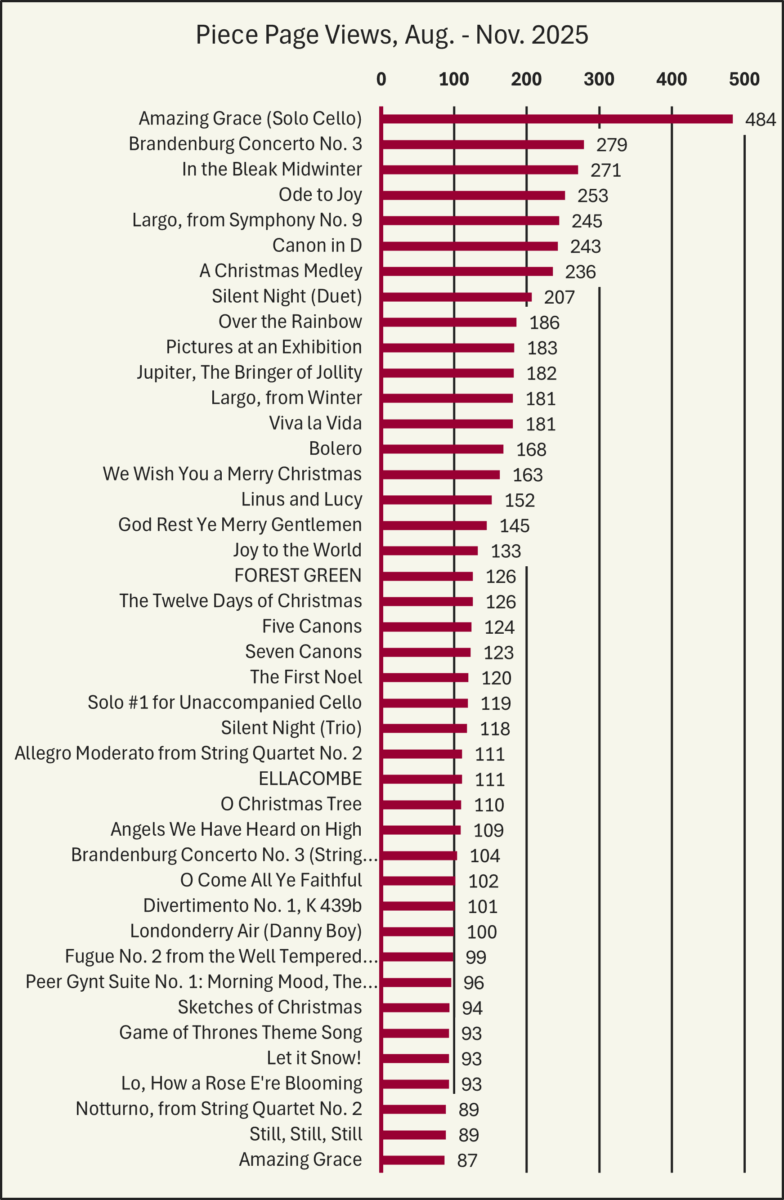
The top 42 pieces in this period averaged one or more views per day, bookended by the arrangements of Amazing Grace for Solo Cello (5.4 views/day) and Amazing Grace for Cello Ensemble (1.0 views/day). The top five here form the “popular” section on the home page (which I manually update a couple times a year). These include Brandenburg Concerto No. 3, which I republished in a complete edition in October under the original URL, modifying the 2013 listing to keep a simplified version. Here are the top 42 in descending order, measured by active users:
The next batch of 45 pieces had between 50 and 86 active users in this time period. The remaining 108 pieces saw between 9 and 49 active users (and 5 pieces were published too late for any data to accumulate). The least popular piece in this period, surprisingly to me, was CRUCIFER, which is perhaps better known by the oft-associated text Lift High the Cross.
The hymn tune arrangements generally perform worse than other genres; however, they’re newer to the library and there are notable exceptions. FOREST GREEN was the most-viewed hymn tune in this period (126), despite being relatively obscure, published in a small percentage of hymnals without a ubiquitous text pairing (but presumably aided by its origins as an English folk tune and adaptation by Ralph Vaughan Williams). ELLACOMBE was next (111), then REPTON (62), with a larger concentration of pieces as view count decreases. These three top performers were all published in July 2025, likely benefitting from their placement in the new releases section.
Popular Orchestrations
Zooming out, it’s difficult to quickly assess popularity by broader taxonomy. But perhaps the most interesting metric is popularity by orchestration. This chart is based on visits to the landing page for each primary orchestration, capturing likeliest intent from visitors looking for music for a particular group configuration:
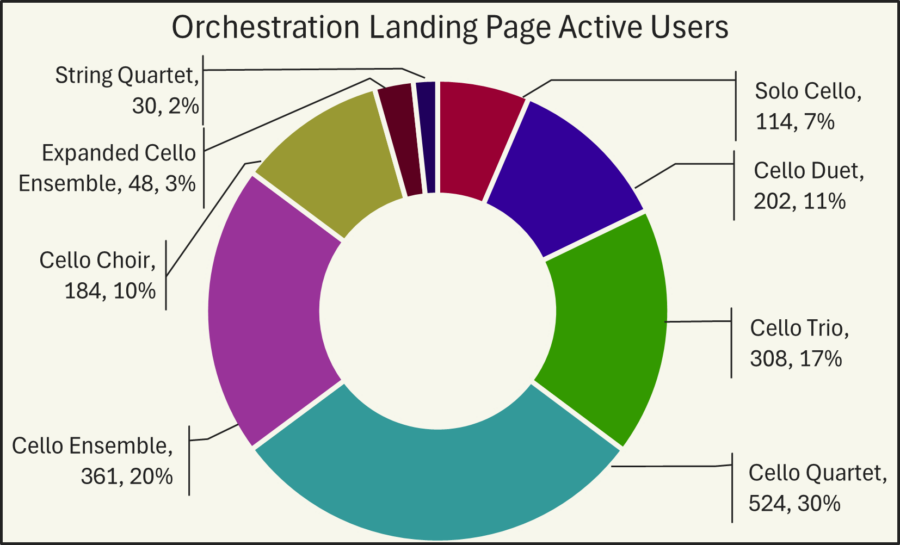
Interest generally matches the distribution in the library, except than there is a relative shortage of cello duet and cello trio arrangements to apparent demand. It’s also entirely possible that activity on the apparently popular orchestrations is driven by their large collections. I plan to work on improving the navigability of these landing pages over time, in addition to building out a better balance of duet and trio pieces. The interest in solo pieces doesn’t directly align with the library’s goals, but presents a strong gateway for cellists to discover the emerging repertoire for larger cello groups.
A (mostly) Free Library
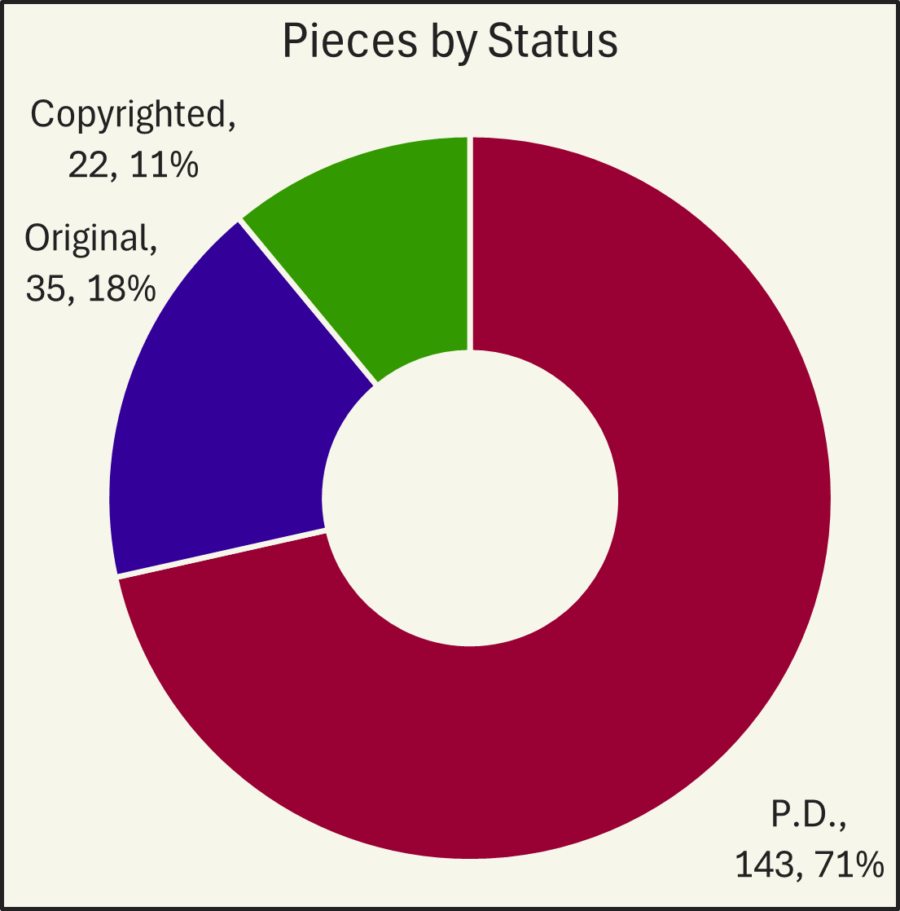
The vast majority of pieces in the sheet music library (71%) are arrangements of public domain pieces. Another 18% are original compositions. The remaining 11% are arrangements of copyrighted pieces, which are managed by the associated publishers and available for purchase via Sheet Music Plus and other platforms. Since launching this format in 2020 and expanding it in 2021, it’s proven to be an effective mechanism to make newer music available to ensembles.
While the 22 copyrighted pieces are included in all of the statistics above, they can be further measured by purchases, which present a more discrete decision point than views or downloads on the website. The following chart summarizes all 286 purchases since mid-2022 and subscription views since 2024. Interestingly, purchases and subscription views are inversely proportional. Every piece has at least two, except for Climb Ev’ry Mountain.
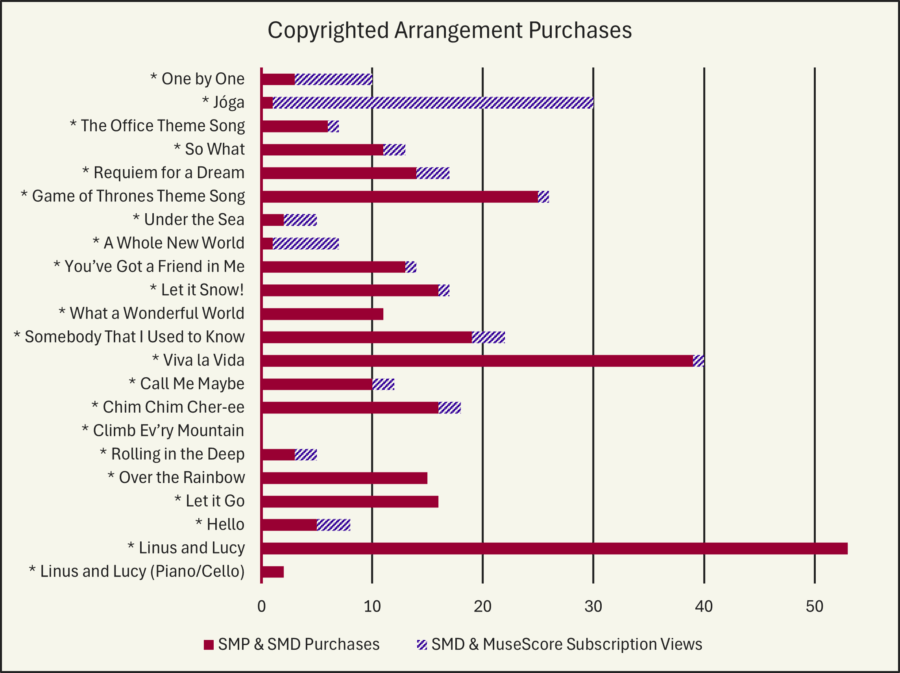
It’s worth reiterating that I only receive 10% of the purchase price, with the remainder going to the publisher and rights holders, who also set the pricing. To date, these commissions have offset less than half of the direct expenses associated with operating the sheet music library, not to mention my time. Therefore, this setup continues to operate under its original purpose to make more music available to more ensembles, not for financial benefit. The goal is still to keep as much of the library as possible free and open for use.
Future Expansion
Following this milestone, and particularly with the high volume of growth in the past couple of years, I plan to reset and slow down the expansion of the library for a while. While I’ll continue to compose and arrange at whatever pace naturally happens, I intend to try restricting the volume to under a dozen pieces per year for the foreseeable future. We’ll see how that goes.